
The 7 best budgeting apps of 2026
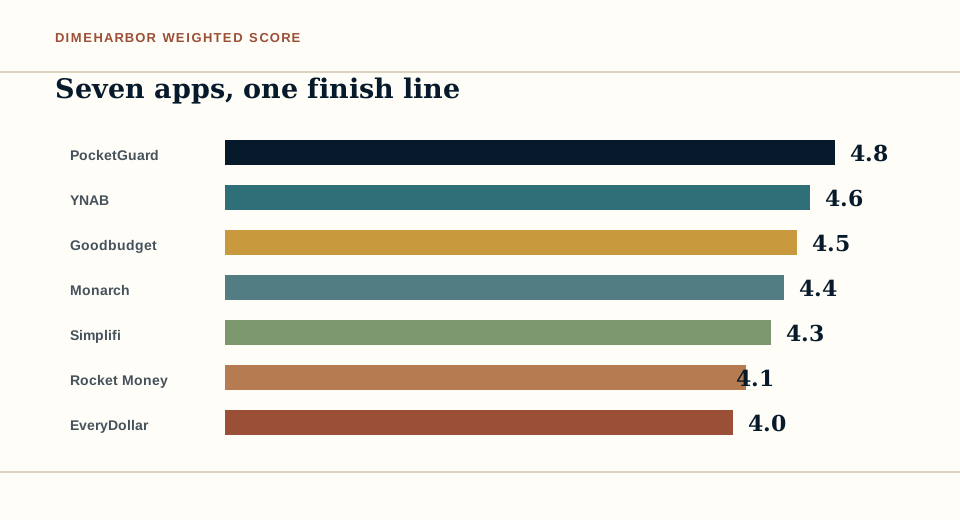
PocketGuard is the best budgeting app for most people in 2026, earning 4.8/5 for clear safe-to-spend guidance and low-maintenance tracking. YNAB ranks second for committed zero-based budgeters, while Goodbudget takes third for shared digital envelopes. We used every app daily for at least four weeks and scored the same five weighted categories.
| Rank | App | Score | Best for | Price checked Aug. 5, 2026 |
|---|---|---|---|---|
| 1 | PocketGuard | 4.8 | Most people | Free; Plus $12.99/mo, $74.99/yr, $99.99 lifetime |
| 2 | YNAB | 4.6 | Zero-based budgeting | $14.99/mo or $109/yr |
| 3 | Goodbudget | 4.5 | Shared envelopes | Free; Plus $10/mo or $80/yr |
| 4 | Monarch Money | 4.4 | Household overview | $14.99/mo or $99.99/yr |
| 5 | Quicken Simplifi | 4.3 | Cash-flow forecasting | Standard $5.99/mo, billed annually |
| 6 | Rocket Money | 4.1 | Subscription cleanup | Free; Premium price shown at signup |
| 7 | EveryDollar | 4.0 | Simple paycheck planning | Free; Premium $79.99/yr |
Prices are official standard U.S. web prices or displayed signup pricing on the check date. Trials, taxes, promotions, app stores, and eligibility can change the final amount.
How we ranked the fleet
Each editor used assigned apps for at least 28 consecutive days, covering a pay cycle and credit-card statement. Tests included connected accounts where supported, recurring bills, refunds, transfers, cash, category corrections, exports, and mobile plus web use. We scored core budgeting at 30%, transaction handling 25%, usability 20%, value 15%, and support and privacy 10%. Read the full DimeHarbor methodology for the protocol.
PocketGuard
Best for most people. PocketGuard’s “In My Pocket” calculation subtracts bills, planned spending, and goals to produce the ranking’s most useful everyday answer. It categorized 89.9% of our 286 test transactions correctly on first review, while flexible limits avoided the rigidity that makes some people quit budgeting.
The catch: connection freshness should be more prominent, investment detail is thin, and the best transaction rules require Plus. Couples also get less deliberate collaboration than Goodbudget offers. Still, the capable free plan and fast setup make PocketGuard the safest general recommendation. Our complete 42-day review shows the weighted math.
YNAB
Best for committed zero-based budgeters. YNAB gives every available dollar a job and teaches users to fund true expenses before they arrive. Its rules, targets, loan planner, sharing, and education form the most coherent budgeting method in this list. It can change behavior, not merely chart it.
The catch: $109 annually is substantial, and the method demands an onboarding investment. New users must understand that they assign money already available, not forecast imaginary income. People wanting automatic, low-touch expense awareness can feel as if they enrolled in a course when they only needed a dashboard.
Goodbudget
Best for shared digital envelopes. Goodbudget makes household priorities visible before money leaves the account. Shared envelope balances work particularly well in a weekly partner check-in, and the free plan provides enough room to learn the real system rather than tour a demo. Manual use remains fully viable for readers avoiding bank connections.
The catch: bank sync requires Plus and eligible U.S. institutions. Free users get one account and two devices; regular manual entry can become a chore. Reports are functional rather than exploratory. Even so, its focused method earns a top-three position and a 4.5 in our 35-day Goodbudget test.
Monarch Money
Best polished household overview. Monarch combines budgeting, goals, net worth, investments, transaction rules, and partner collaboration in an unusually calm interface. Custom dashboards and flexible categories suit households that want spending and wealth visible together without adopting YNAB’s specific doctrine.
The catch: there is no ongoing free plan, and $99.99 annually creates a high bar when PocketGuard and Goodbudget can be tested indefinitely for free. Connections can still depend on aggregators, despite Monarch’s provider choices. The budgeting layer is capable, but its breadth sometimes feels like the product’s real selling point.
Quicken Simplifi
Best for projected cash flow. Simplifi’s spending plan accounts for income, bills, subscriptions, planned spending, and savings goals without forcing every dollar into an envelope. Watchlists provide focused limits on merchants or categories, and projected balances help expose timing trouble before a bill lands.
The catch: promotional pricing can make the eventual renewal rate easy to overlook, so inspect the term at checkout. There is no permanent free tier. Quicken’s feature vocabulary also takes time to parse: a spending plan, watchlist, and projected cash flow overlap until the workflow becomes familiar.
Rocket Money
Best for finding subscription drag. Rocket Money excels at surfacing recurring charges, tracking bills, and turning forgotten subscriptions into an actionable list. Its budgeting and net-worth tools make it broader than a cancellation service, and the free experience can reveal whether recurring expenses are the real leak.
The catch: Premium pricing may be presented during signup rather than as one stable public rate, which complicates comparison. Bill negotiation can involve a share of savings, so read the service terms before authorizing it. Budgeting is useful, but not as deep or behaviorally coherent as the leaders.
EveryDollar
Best for a simple paycheck plan. EveryDollar presents zero-based budgeting in a straightforward monthly layout. Dragging planned amounts between categories is approachable, the free manual version keeps the core idea accessible, and users following the broader Ramsey system will recognize the language and sequence.
The catch: the free plan is heavily manual, while Premium costs $79.99 per year and remains closely tied to one financial philosophy. Reporting and customization trail more flexible competitors. It is effective for readers who want exactly its method; it offers less room for households that prefer nuanced debt or investment choices.
How to make the shortlist useful
Before choosing software, our six-month spending tide table shows the data an app should clarify. Do not install seven apps. Pick two with different methods, test their free plan or trial through one pay cycle, and record three facts: how often you corrected data, whether the app changed a decision, and whether you still opened it after day 14. Price is wasted if the system becomes another unopened icon.
For the broadest starting point, compare PocketGuard and Goodbudget in our category-by-category head-to-head. If neither fits, the eight-question app guide routes by automation, income pattern, household, and privacy preference. The best app is not the one with the most rigging; it is the one that helps you steer next Tuesday.